


Team Viz
By Orit Alul, Chief Architect at Viz.ai
Healthcare is undergoing a data transformation. At the heart of this shift are modern interoperability standards and AI advancements that are reshaping clinical workflows.
One of the most transformative innovations in this space is the emergence of large language models (LLMs). These models are redefining how we interact with data, process clinical information, and deliver insights. But the true catalyst for meaningful change isn’t just the sophistication of LLMs, it’s the increasing availability and accessibility of high-quality healthcare data.
Regulatory efforts like the ONC Cures Act and the widespread adoption of the HL7 FHIR (Fast Healthcare Interoperability Resources) API standard have removed many of the historical barriers to data exchange. As a result, vendors like Viz.ai can now securely and efficiently access clinical data directly from electronic health records (EHRs), accelerating the path from raw data to actionable insight.
FHIR: A Game-Changer in Healthcare Interoperability
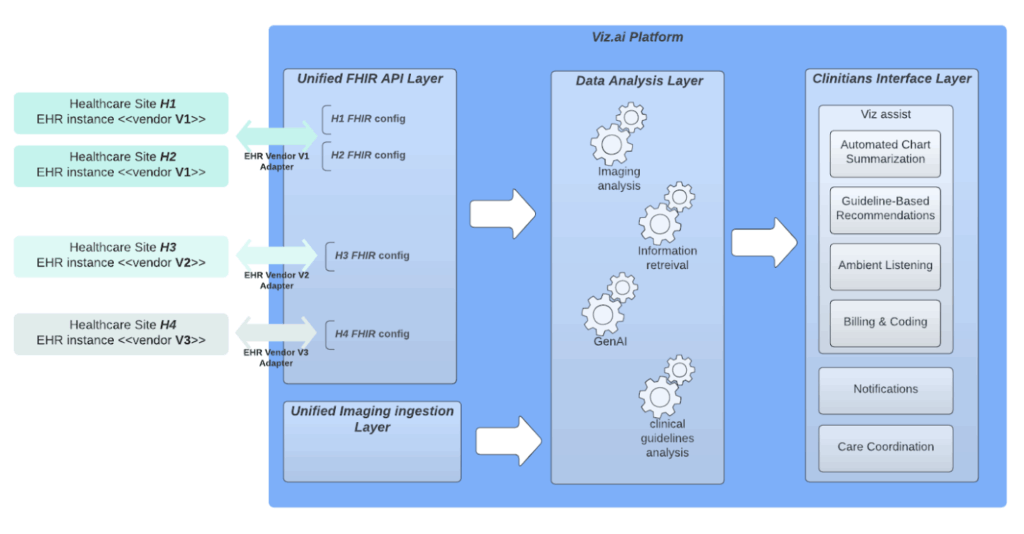
The Fast Healthcare Interoperability Resources (FHIR) API is a modern, RESTful interface that enforces a standardized format across healthcare systems. This uniformity is crucial: it allows us to integrate across a wide range of healthcare sites and EHR vendors without custom-built interfaces or major provider-specific customization, though there are occasionally minor variations or nuances between EHR vendors’ implementations. Whether a healthcare provider uses one of the larger or smaller EHR vendors, FHIR ensures data is accessed in a consistent, structured way.
FHIR exposes a variety of clinical and administrative resources, such as Patient, Condition, Observation, Document Reference, Encounter, and many more, that allow applications to extract relevant patient data in a normalized format. Importantly, healthcare providers maintain full control over which FHIR resources are exposed and to whom, enabling role-based access and scoping data sharing to specific clinical use cases, ensuring alignment with privacy and compliance requirements.
Furthermore, the FHIR standard supports public endpoints secured via OAuth 2.0 with support for JWT-based access tokens and JSON Web Key Set (JWKS) for dynamic key rotation and validation. This provides strong guarantees around the confidentiality, integrity, and authenticity of access tokens. Unlike legacy integration methods, OAuth 2.0 combined with JWKS ensures secure, auditable access without relying on static shared secrets or manual key management. For healthcare organizations, this means secure interoperability with minimal burden on internal IT resources. No need for VPNs, custom interface engines, or extensive infrastructure changes.

Known Limitations and Practical Workarounds
While FHIR excels in standardized data access, it currently lacks robust support for real-time event-driven communication. This makes it difficult for applications to be notified immediately when new clinical data becomes available. At Viz.ai, we’ve mitigated this limitation through a combination of approaches. We implement periodic data pulls to ensure our systems are regularly updated with the latest patient information, and we also leverage CDS Hooks – a specification that allows external systems to be notified when certain clinical workflows are triggered. While not a full substitute for native real-time FHIR subscriptions, this hybrid strategy enables us to inject intelligent decision support into clinical workflows with minimal delay and high clinical relevance.
Scaling AI with Confidence and Speed
With a footprint across more than 1,800 hospitals, this modern data infrastructure allows us to scale our LLM-powered solutions quickly, securely, and effectively across multiple healthcare sites. We’re not just solving isolated problems at individual sites, we’re building a platform that works broadly across the healthcare ecosystem. This scalability is essential to delivering widespread impact.
Our approach stands apart because we combine imaging-based AI with advanced EHR data analysis. This multimodal approach, bringing together structured and unstructured clinical data, medical imaging, and the power of LLMs, is exemplified in the recent launch of Viz Assist. Viz Assist is a suite of autonomous AI agents that significantly enhance how care teams identify, prioritize, and act on critical patient data. Viz Assist leverages these capabilities to provide a more holistic understanding of each patient’s clinical trajectory, supporting more accurate, efficient, and personalized care at scale.
LLMs: Relieving the Cognitive Load on Clinicians
Clinicians are drowning in data. A single patient can have hundreds, sometimes thousands, of documents stored in their EHR, making it a significant challenge to extract relevant clinical context quickly and efficiently. This cognitive burden not only affects productivity and can delay critical clinical decisions, but it also increases the risk of missed information or human error, especially when clinicians are under time pressure.
This is exactly the challenge Viz Assist was built to solve. Powered by advanced large language models, Viz Assist surfaces the most relevant patient information by summarizing, organizing, and highlighting key clinical data within the workflow. It acts as a trusted digital assistant, reducing the cognitive load on care teams, minimizing time spent searching through documentation, and allowing clinicians to focus on delivering care.
With the right safeguards and human oversight in place, Viz Assist demonstrates how LLMs can be responsibly integrated into clinical practice, augmenting decision-making, preventing burnout, and helping deliver better outcomes faster.
Responsible and Explainable AI
Responsible AI is foundational to how we build and deploy technology. We prioritize transparency, explainability, and clinical validation across every feature we build and deploy. We work closely with clinicians to ensure the generated outputs are interpretable, relevant, and actionable, because trust is the foundation of clinical adoption.
Driving Better Outcomes Through Innovation
The convergence of accessible healthcare data, modern interoperability standards like FHIR, and the power of large language models is creating a new era of intelligent healthcare applications. With these capabilities, we can make clinicians more efficient, reduce administrative burden, and ultimately drive better patient outcomes.
Our work at Viz.ai builds on this foundation. By combining imaging-based AI, structured and unstructured EHR data, and advanced LLMs, we’re designing systems that deliver context-aware, actionable insights directly into clinical workflows. Solutions like Viz Assist exemplify how AI can function as a trusted clinical collaborator—surfacing the right information at the right time to support faster, more informed decisions.
Reimaging the Future of Intelligent Care
As healthcare continues to digitize, the next frontier isn’t just about creating smarter algorithms. It’s about building intelligent, interoperable systems that earn clinicians’ trust and work seamlessly within existing workflows.
At Viz.ai, we’re committed to advancing this transformation responsibly. That means grounding every innovation in transparency, explainability, and clinical validation to ensure AI augments rather than replaces human judgment.
By unlocking the potential of healthcare data and embedding intelligence where care happens, we’re shaping a future where technology empowers clinicians, accelerates decisions, and ultimately elevates patient care everywhere.