


Nov 19, 2026
Advancements in oncology care options have outrun the pace at which any single clinician can keep up.
By Rebecca Maniago, PharmD, BCOP, Senior Director, Oncology Care Pathway, Viz.ai

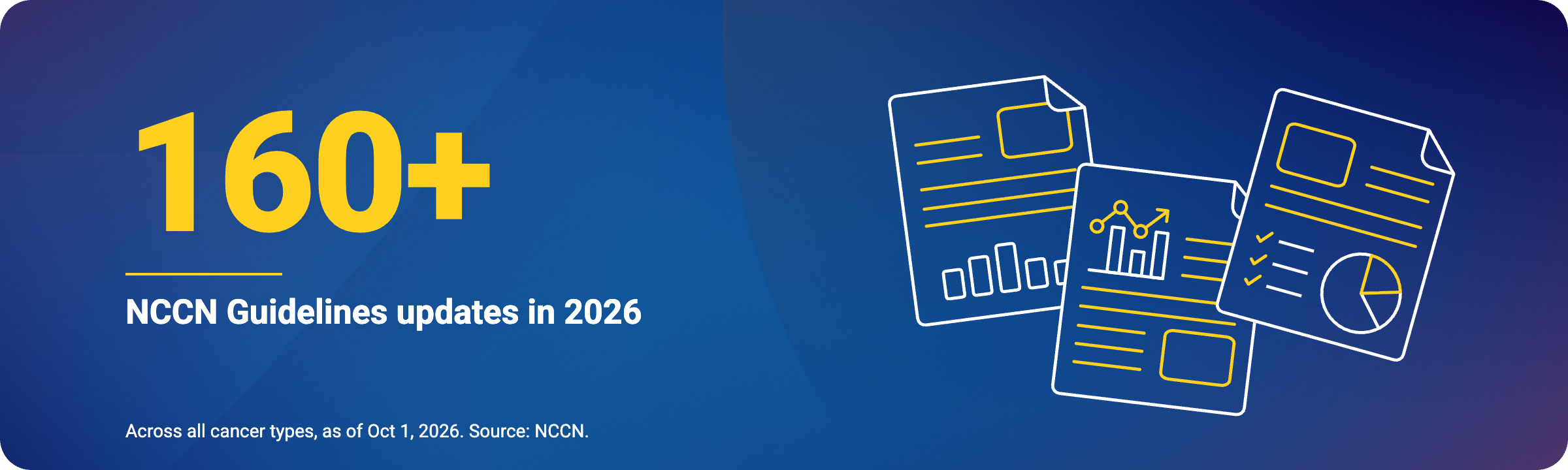
New approvals arrive continuously. Treatment selection branches on biomarker results that did not exist five years ago. Sequencing questions that used to have one reasonable answer now have four. In 2026 alone so far, the National Comprehensive Cancer Network (NCCN) Guidelines have been updated over 160 times across all cancer types as of October 1.1 Staying current has quietly become a second job layered on top of a full clinic schedule. However, guideline-directed care is how the field keeps pace without leaving patients behind.
For health systems, a care coordination platform could be the solution. The question is, how do you ensure a care coordination system lessens the burden on physicians while still allowing clinician led, guideline-directed care?
The case for guideline-directed care
Guidelines, such as the NCCN Guidelines for oncology provide evidence-based, expert-consensus recommendations that are intended to standardize cancer care, help improve patient survival, and increase access to the most effective treatments.
Key factors that support the need for guideline-directed care include:
- Variation in cancer care. Patients with the same diagnosis, stage, and biology can receive meaningfully different treatment based on social determinants such as location.2
- Concordance is associated with better outcomes. One SEER-Medicare study of older women with breast cancer found non-concordant care was associated with higher hazards of breast cancer death.3
- Concordance supports access. When a guideline lists a therapy for a given indication, that listing supports insurance coverage and prior authorization. Documented guideline alignment may often be what stands between a patient and a covered therapy.
- Guidelines help reduce cognitive load. They settle the decisions that should not require deliberation, which preserves clinical attention for the ones that do.
Why NCCN is the most widely used US reference4
The National Comprehensive Cancer Network (NCCN), an alliance of leading cancer centers, publishes what most United States oncology programs treat as the gold standard. Four features that set NCCN apart include:
- Constant updates. Some disease sites are revised several times a year, sometimes within weeks of a major trial readout or a new approval.
- Evidence grades. Recommendations carry a category (1, 2A, 2B, 3) that reflects both the strength of the underlying evidence and the degree of panel agreement. A Category 1 recommendation and a Category 2B recommendation support very different conversations with a patient.
- Deliberate permission. Where clinical equivalence exists, the guidelines present them as co-equal options rather than naming a winner.
- Clinical trials first. The network’s stated position is that enrollment in an open clinical trial is the preferred management for patients with cancer regardless of their clinical scenario.
What staying current actually costs
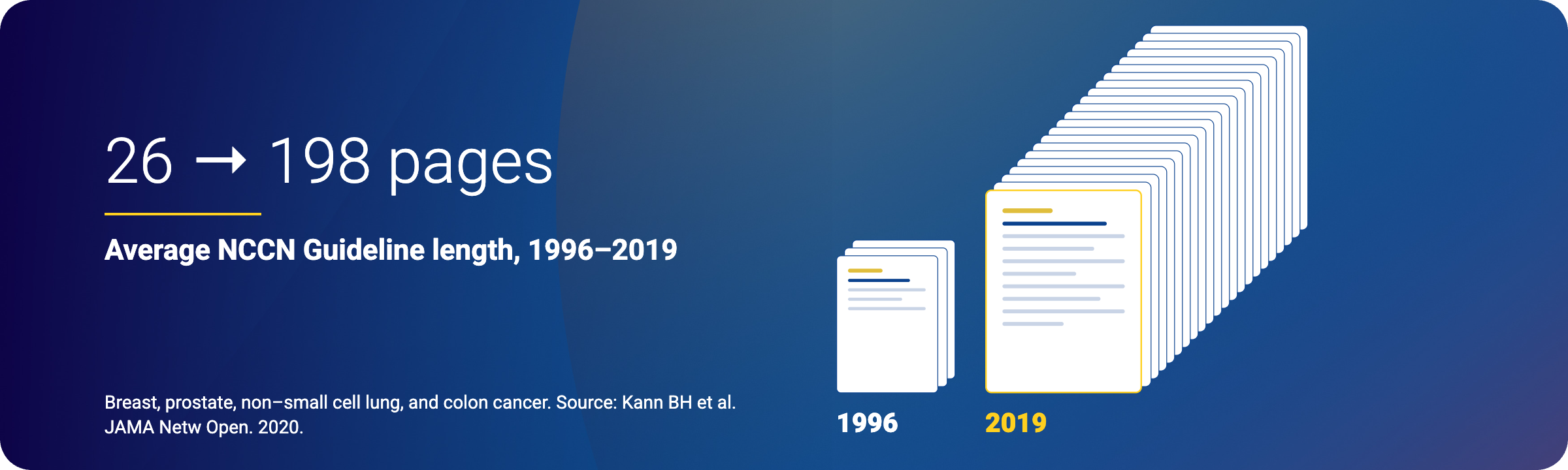
An analysis of NCCN Guidelines for four common cancers (breast, prostate, non–small cell lung, and colon) found that average guideline length grew from 26 pages to 198 pages over a 23 year period, while cited references grew more than 30-fold over the same period.5
In practice, clinicians are often asked to close the gap in the least efficient way available. They look things up mid-clinic. They check a recommendation they already know, to make sure it didn’t change last month. They may even carry a low-grade uncertainty about whether the version in their head is the current one, which can cost time whether or not anything has actually changed.
That effort doesn’t appear in a productivity report. It can show up as hours after clinic, delayed treatment starts, and as a meaningful contributor to burnout in a specialty already carrying high rates of it.6, 7
Technology offers a solution. The best clinical decision support systems are taking the burden of guideline-directed care lookup off the clinician and embedding answers at the point of care.
What that design demands of software
There are certain features that clinical decision support systems need to address, and they are not incidental. They set the bar.
Currency is a safety issue, and a time issue. If guidelines are revised several times a year, the lag between publication and what appears on screen can become a clinical risk. It is also the difference between a tool clinicians trust enough to rely on and one they feel obliged to double-check, which returns the time burden to exactly where it started.
Fidelity means preserving the options. Software wants a single answer. Guidelines often refuse to give one. A platform that collapses four co-equal regimens into one default has substituted a product decision for a clinical one. The evidence category should be immediately visible, not buried.
Recommendations are only as good as their inputs. Guideline logic depends on stage, histology, biomarker status, performance status, and prior lines of therapy. Know where the data is coming from and how it was validated. A confident recommendation built on a misread biomarker result is more dangerous than no recommendation at all.
Trials belong in the workflow. If the guidelines name trial enrollment as preferred management, a platform that treats open trial enrollment as a deviation from the pathway has the logic backwards.
Clinical decisions live with providers
Oncologists may make nuanced off-pathway decisions for good reasons: trial enrollment, significant comorbidity, declining functional status, patient preference, and goals of care near the end of life. Each of those is a clinical decision, not a deviation.
A guideline-backed clinical decision support tool should help clinicians make informed decisions about their patients’ care; not make the decision for them. With the incorporation of AI tools at the point of care, concordance data can then be used as an additional quality and learning instrument for health systems. Systems adopting these tools should decide upfront who sees concordance reporting, at what level of aggregation, and what it may and may not be used for. The nuance in the provider-patient decision making process cannot be overlooked.

How Viz Oncology approaches this
Viz Oncology provides clinical decision support. Clinical decisions remain the responsibility of the treating provider. That is why Viz Oncology was built around the premise that clinical decision support has to respect how guidelines are actually written, and the difficulty that exists with keeping up with them, to help physicians deliver guideline-aligned care.
- Current content, visible versioning. Viz.ai collaborates with NCCN within Viz Oncology, which is designed to reflect the most recently published NCCN Guidelines for breast, prostate, and bladder cancer, with version and date shown.
- Options preserved, evidence graded. Guideline-directed, therapy-agnostic care options are presented with clear evidence grades so care teams can make informed clinical decisions for their patients.
- Transparent inputs. Through customer-authorized EHR integrations, structured and unstructured patient data is used to align guideline options with the patient’s clinical scenario.
- Trials surfaced at the decision point. Relevant open trials are surfaced based on patient specific criteria and care teams can be notified at the point of care.
- Configurable to your institution. EHR integrated to fit into existing clinical workflows.
Guidelines do not replace clinical judgment. They help judgment start from the current standard of care rather than from memory, and they should not cost a clinician their evening to do it.
See how guideline-directed clinical decision support can work in your setting. Book a demonstration with our clinical team.
References
- Pulled from NCCN website based on latest versions represented across cancer types. Accessed on Oct. 1, 2026. Treatment by cancer type. NCCN. (2026). https://www.nccn.org/guidelines/category_1
- Abdullah A, Liu Z, Molinari M. From Diagnosis to Survivorship: The Role of Social Determinants in Cancer Care. Cancers (Basel). 2025 Mar 22;17(7):1067. doi: 10.3390/cancers17071067. PMID: 40227566; PMCID: PMC11987860.
- Herbach EL, Carnahan RM, McCullough LE, McDowell BD, Curran M, Wang K, Lizarraga IM, Charlton ME, Nash SH. Guideline-concordance along the cancer care continuum and breast cancer mortality by race and ethnicity: a SEER-Medicare study. Cancer Causes Control. 2026 Jan 21;37(2):33. doi: 10.1007/s10552-025-02099-9. PMID: 41563590; PMCID: PMC12823728.
- Koh, W.-J., Anderson, B.O. and Carlson, R.W. (2020), NCCN resource-stratified and harmonized guidelines: A paradigm for optimizing global cancer care. Cancer, 126: 2416-2423. https://doi.org/10.1002/cncr.32880
- Kann BH, Johnson SB, Aerts HJWL, Mak RH, Nguyen PL. Changes in Length and Complexity of Clinical Practice Guidelines in Oncology, 1996–2019. JAMA Netw Open. 2020 Mar 2;3(3):e200841. doi: 10.1001/jamanetworkopen.2020.0841. PMID: 32167566; PMCID: PMC7070231.
- Trends in well-being and burnout among U.S. oncologists: challenges and solutions. JCO Oncol Pract. 2025;21(7):1045-1046. Published online January 29, 2025. doi:10.1200/OP-24-00816 https://ascopubs.org/doi/full/10.1200/OP-24-00816
- Markman M. Oncologists spend too little time with patients, too much on EHR. Medscape. April 26, 2018. Accessed November 9, 2026. https://www.medscape.com/viewarticle/895319
Viz Oncology
Enabling personalized cancer treatment at scale, with NCCN guidelines recommendations incorporated directly in the workflow
Learn more