


2025 Black Book AI-Powered Acute Care and Clinical Decision Support Solutions Report
Viz.ai Named #1 in 2025 Black Book Survey of AI Powered Acute Care & Clinical Decision Support Vendors
Jul 23, 2025

Team Viz
Jan 14, 2026

As a practicing physician, I often hear the narrative that physicians are skeptical of AI. The data tells a very different story.
A newly released 2025 Physicians AI Report, based on a survey of 1,000+ physicians across 106 specialties, shows that clinicians are not only open to AI — they’re already using it, believe in its value, and want more of it. The bottleneck is less about clinician skepticism and more about the infrastructure around them.
Health administrators are in a genuinely hard position: clinicians want new AI tools, yet many solutions are unproven, require extensive IT lift, and introduce real governance burdens. Aligning clinical enthusiasm with organizational readiness — even when the value case is clear — remains one of healthcare’s biggest challenges.

One of the most striking findings from the report is the level of real-world AI usage among physicians:
When asked which AI tools they actually use, physicians named a mix of general-purpose tools like ChatGPT — often through personal subscriptions — and healthcare-specific solutions deployed by their health systems.Notably, Viz.ai was one of the only clinical decision-support platforms to appear on the list, which was otherwise dominated by broad LLMs like ChatGPT and Claude as well as a multitude of tools that exclusively offer basic ambient documentation support.

Despite high personal adoption, 81% of physicians report dissatisfaction with how their employer is deploying AI.
Three issues emerge consistently:
More than 70% of physicians say they have little or no influence over which AI tools their organization purchases. I was a bit surprised by this number. All of the Chief Medical Information Officers I’ve spoken to – usually 2 per week – have regular engagement with clinicians on the front line and in day-to-day realities. But the stakeholders are several: IT, data governance, finance. On the one hand, more input could be more robust. On the other hand, more input slows down an already very complex process.
There are also different cultural norms surfacing. While some clinicians may be willing and eager to be first adopters and push through the kinks and learning curve of an evolving technology, administrators may lean more risk averse and want to see broad adoption of a tool before they adopt it themselves.
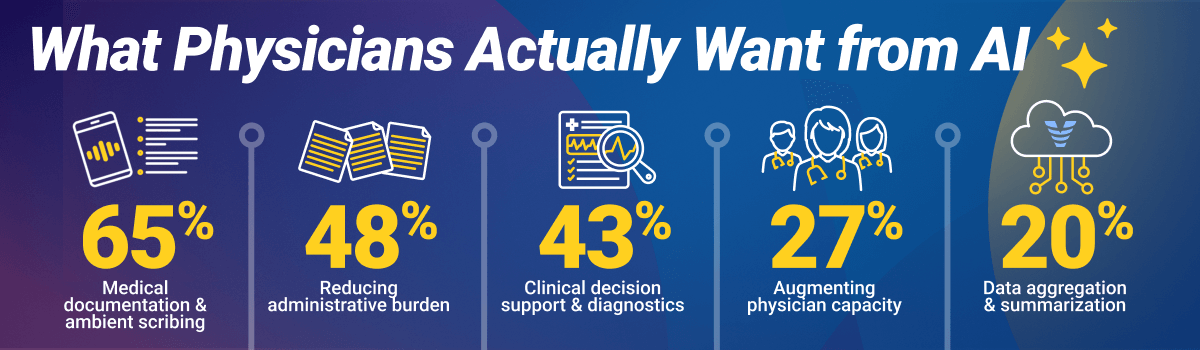
While documentation relief ranks highest, nearly half of physicians cite decision support and diagnostics — signaling that AI must do more than save clicks. It must help clinicians deliver better outcomes at the point of care.
To move beyond the current gridlock, both clinicians and administrators need a clearer framework for how AI decisions are made and why.
Physicians don’t need to be convinced that AI works. Neither do administrators. But they each need one another to find where the best use cases are and to navigate together how to efficiently get them implemented.
Successful AI programs:
At Viz.ai, our philosophy is simple:
AI should support clinicians at the point of care and help patients receive the right care at the right time. This means meeting both clinicians and hospital leadership where they are, listening, and advancing their mission alongside them.
Viz.ai Named #1 in 2025 Black Book Survey of AI Powered Acute Care & Clinical Decision Support Vendors
Jul 23, 2025
How Pharma Can Lead Through HCP and Tech Collaborations
Jun 17, 2025