The Full Picture: What It Takes to Make an Informed Stroke Transfer Decision
What the 2026 AHA/ASA guideline means for community hospitals deciding whether a stroke patient stays or transfers.
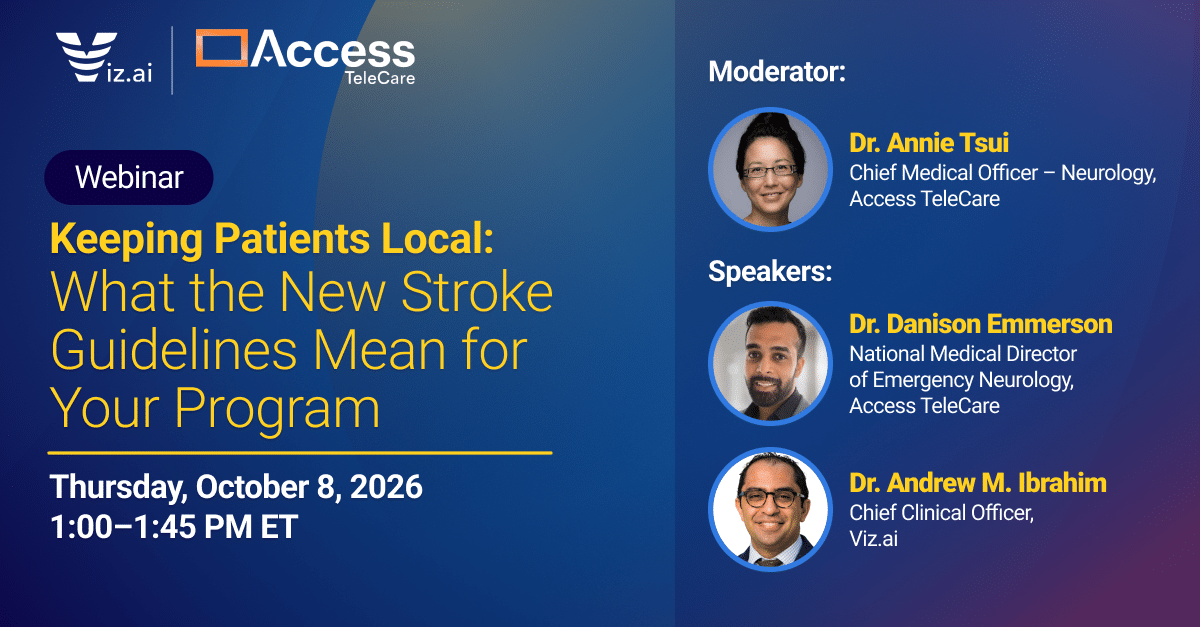
On October 8, Viz.ai and Access TeleCare held a webinar on the 2026 AHA/ASA guideline for acute ischemic stroke and what it means for hospital networks.1 Dr. Annie Tsui, Chief Medical Officer of Neurology, and Dr. Danison Emmerson, National Medical Director of Emergency Neurology, joined from Access TeleCare, with Dr. Tim Showalter, Chief Medical Officer of Viz.ai. One point from Dr. Emmerson is worth repeating: Deciding whether a patient stays or transfers, he said, “is never a unilateral decision.” It takes the family, the emergency team, neurology, neurosurgery or neurointervention, and local critical care.
At a community hospital in the middle of the night, those people are rarely in the same room, and they are rarely looking at the same images. The local team is caring for someone on one of the worst days of their life, often without a clear view of every option. Sending that patient to a larger center is sometimes the right call. The team deserves to make it with the full picture.
The guideline leans harder on the local hospital
Three parts of the 2026 guideline raise the stakes on that decision.1
Where a stroke system of care is well coordinated and the local hospital is proficient at thrombolysis and secondary interhospital transfer, the guideline finds no three-month outcome benefit in transporting patients with suspected large vessel occlusion (LVO) past it to a thrombectomy-capable center 45 to 60 minutes away (COR 3: No Benefit).
Hospitals and EMS should have agreements and protocols that prioritize transfer for patients who need a higher level of care, to reduce door-in-door-out time (COR 1).
Thrombectomy now extends to selected patients with larger infarct cores, and to basilar artery occlusion within 24 hours (COR 1). More patients are candidates for the hub.
Read together, they ask a community hospital to do two things well: care for the patients it can, and move the patients it must without delay.
Five things tip the decision. One is the patient.
Dr. Showalter named five things that tip keep-or-transfer at 2 AM.
Only the first, where the occlusion is, is about the patient. The other four are about the hospital and the hour: what imaging the site can produce, whether a neurologist is available, whether there is a bed, and what the protocol says. At 2 AM, Dr. Showalter said, “the anatomy alone rarely settles the decision.” When one of the other four is unknown, the local team is deciding without the full picture, and transfer can be the only option it can see.
Image review and communication: where Viz.ai helps
Software does not open an ICU bed or write a protocol. What it can do is give everyone in the decision the same images and one place to talk. The local team sees its options, and the hub is part of the conversation from the start.
Image review: the same study on every screen
The study is analyzed automatically. Viz LVO analyzes the CT angiogram, flags a suspected large vessel occlusion and notifies the stroke team. Viz CTP returns core and penumbra volumes and the mismatch ratio from the hospital’s own scanner. Viz ICH Plus includes non-contrast CT quantification of hyperdensity and midline shift is time-stamped for the record.
The images reach the people deciding. The ED attending gets the same alert and images as the neurologist, on a phone or a desktop. The teleneurologist joins by video, already on the same study. If the patient may need to move, the hub sees the images too.
The official read does not change. Radiology still issues the interpretation and report. Decision support does not replace this.
The guideline calls for emergent brain imaging protocols as quickly as possible for thrombectomy selection. Its supporting text notes that automated analysis and detection applications can offer workflow advantages, including early LVO recognition and team activation. Where the guideline brings perfusion imaging into a treatment decision, it specifies automated postprocessing software.1
Communication: one thread for the whole team
Everyone gets the Viz alert. The ED attending receives the same alert as the neurologist and can advocate for the patient before teleneurology is on screen.
One Viz conversation, next to the images. The ED attending, the teleneurologist and the hub team message in one HIPAA-compliant thread, in the same application they use to view the study.
The hub is already on the platform. If the patient does need to move, transport and the door-in-door-out clock start together.
Dr. Emmerson described what this looks like when it works: specialists “already on the call or on the messaging chain,” and a team that can say together, in his words, “I think we can keep this patient here versus we need to transfer them.” Either answer can be right. What changes is that the team reaches it together, with the same information.
The right transfers, faster
None of this argues against transfer. The aim is to transfer the right patients, and the published evidence is consistent with that.
At one primary stroke center, mean door-in-door-out time for LVO transfers was 102.3 minutes shorter after Viz LVO was implemented (226.7 versus 124.4 minutes; single center, 63 patients).2
Across a five-hospital spoke network, the share of transfers that went on to thrombectomy rose from 32.1% to 45.7% after implementation.3
In a cluster-randomized trial at four comprehensive stroke centers, automated LVO detection with secure team messaging shortened door-to-groin time by 11.2 minutes. The guideline cites this trial, which used Viz.ai software.4
When we asked the webinar audience where their biggest gap is, door-in-door-out came first and door-to-needle second. Both measure how quickly a team can act on the same information.
Three questions for your next stroke committee
Can your team see the same imaging at 2 AM that it sees at 2 PM?
Of the stroke patients you transferred last year, how many were treated at the hub?
Is your keep-or-transfer protocol written down, and does it say who is on the thread?
Dr. Showalter added that technology now “helps us have these multidisciplinary conversations to move towards the right treatment for each patient.” Whether that happens at 2 AM depends on what the team can see and how quickly its members can reach each other. That part is within a program’s control.
Viz.ai and Access TeleCare will both be at SVIN in Las Vegas, November 18th to 20th, 2026.
References
Prabhakaran S, et al. 2026 Guideline for the Early Management of Patients With Acute Ischemic Stroke. Stroke. 2026;57:e316–e436. doi:10.1161/STR.0000000000000513
Hassan AE, et al. The implementation of artificial intelligence significantly reduces door-in-door-out times in a primary care center prior to transfer. Interv Neuroradiol. 2023;29(6):631–636. doi:10.1177/15910199221122848
Bonner J, et al. Should they stay or should they go? Stroke transfers across a hospital network pre- and post-implementation of an automated image interpretation and communication platform. Interv Neuroradiol. Published online August 14, 2024. doi:10.1177/15910199241272652
Martinez-Gutierrez JC, et al. Automated Large Vessel Occlusion Detection Software and Thrombectomy Treatment Times: A Cluster Randomized Clinical Trial. JAMA Neurol. 2023;80(11):1182–1190. doi:10.1001/jamaneurol.2023.3206
Viz.ai products referenced are FDA 510(k)-cleared for quantification, triage and notification. They are not intended to replace diagnostic interpretation or clinical judgment.